G
Gustavo Pacheco
Photographer · Tour Guide · Zürich
7 min read
7 min de lectura
7 Min. Lesezeit
It was a cool April morning — around 19 degrees. I walked ten minutes to the train station in Schofflisdorf with a cold Quöllfrisch in my hand. Something that had already become a ritual on days when I was heading into Zürich with my camera. But this day was different: it was my first Sechseläuten.
The year before, I had watched it from my phone, more than 8,000 kilometres away. A bit insane? Yes. Absolutely. And here I was.
On the train, at every stop, you could already feel it. By the time I arrived at Zürich HB, I was met head-on by a human tide in motion — costumes, musicians, photographers, everyone moving toward the same place. I had no idea where to start. I just knew I wanted it to be authentic. So I did the simplest thing possible: I walked toward the music.
That's how I found the parade.
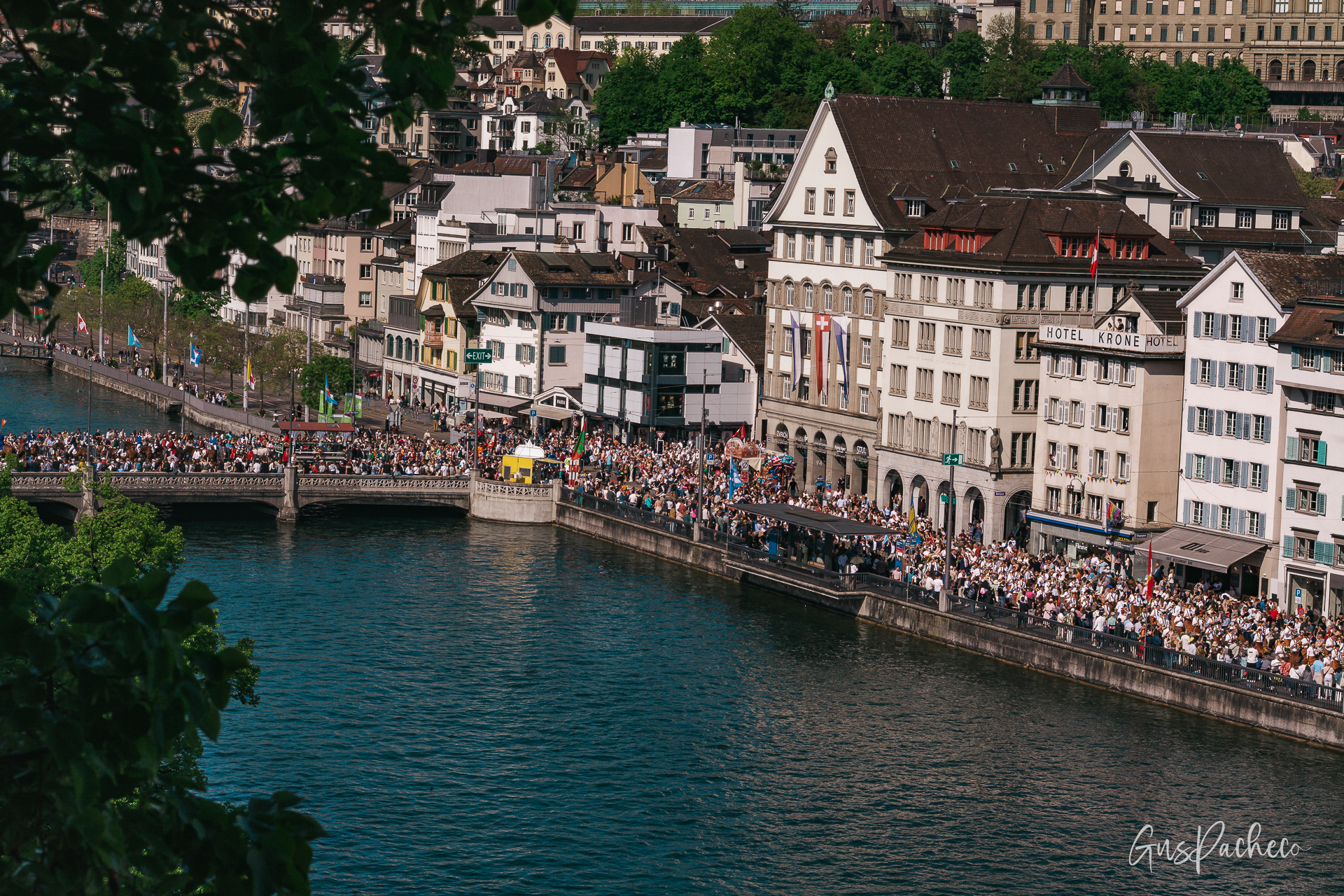
The scale of the event from above: the parade filling the Limmatquai, the Fraumünster tower in the background. This is the Zürich you don't see in travel brochures. © Gus Pacheco
What Is Sechseläuten?
The name means "the six o'clock ringing" — the moment when the bells of the Grossmünster would ring to announce the end of the winter working day. For centuries, this was how Zürich marked the turning of the season. Today it happens every third Monday of April and it's one of the most spectacular things I've ever photographed.
More than 25 guilds (*Zünfte*) of Zürich gather in a parade that winds through Bahnhofstrasse, Paradeplatz, and along the Limmat before arriving at Sechseläutenplatz in front of the Opera House. Each guild represents centuries of tradition — bakers, carpenters, merchants, millers, each with their own costume, their own music, their own character. There are horses, decorated floats, brass bands, and people in period dress who genuinely look like they stepped out of 1631.
And at 6pm, they burn a snowman.
The Böögg has been predicting the Swiss summer for over 160 years. The faster the head explodes, the better the summer. The whole city watches in silence — and then erupts.
— Zürich Spring Ritual · First documented 1892
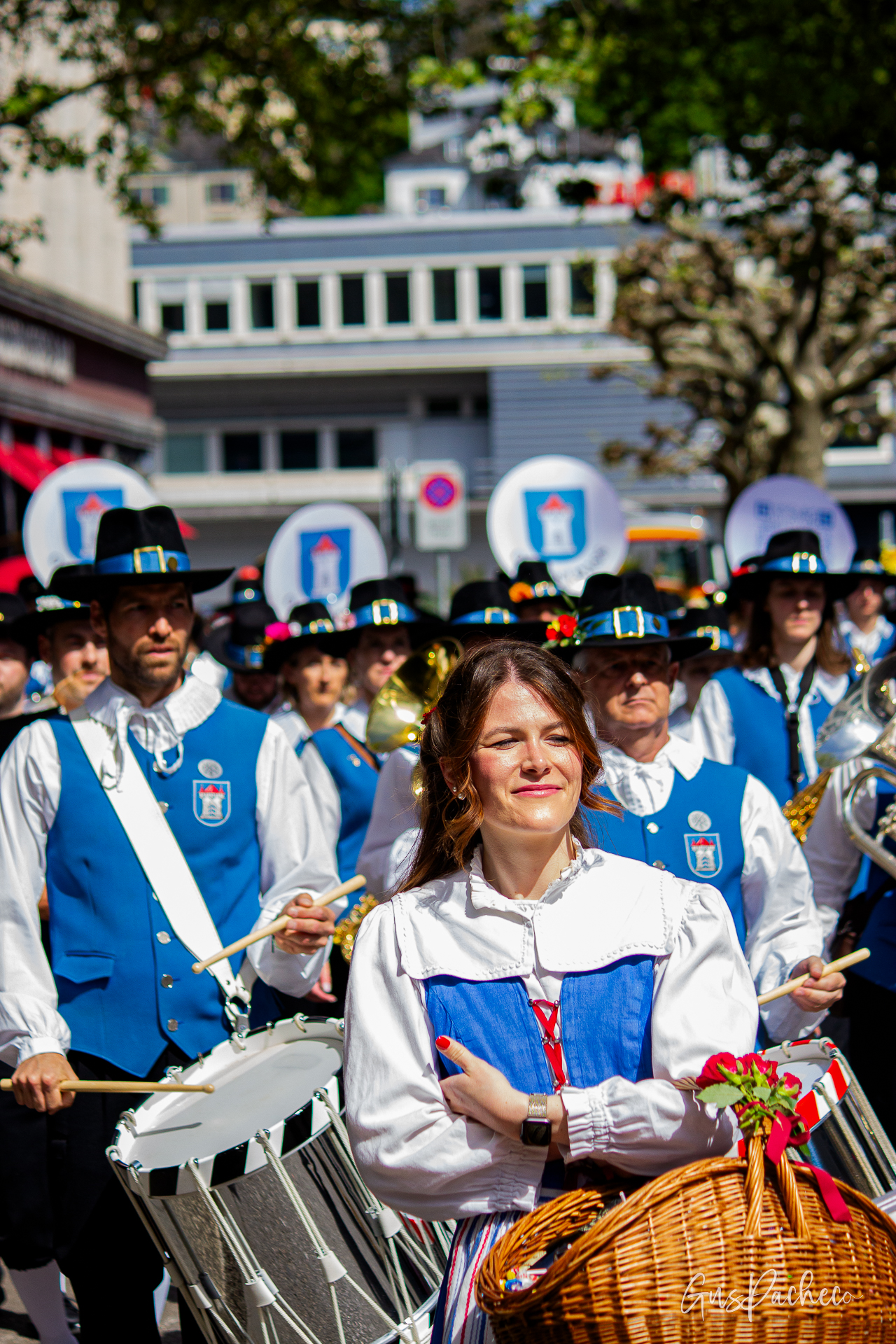
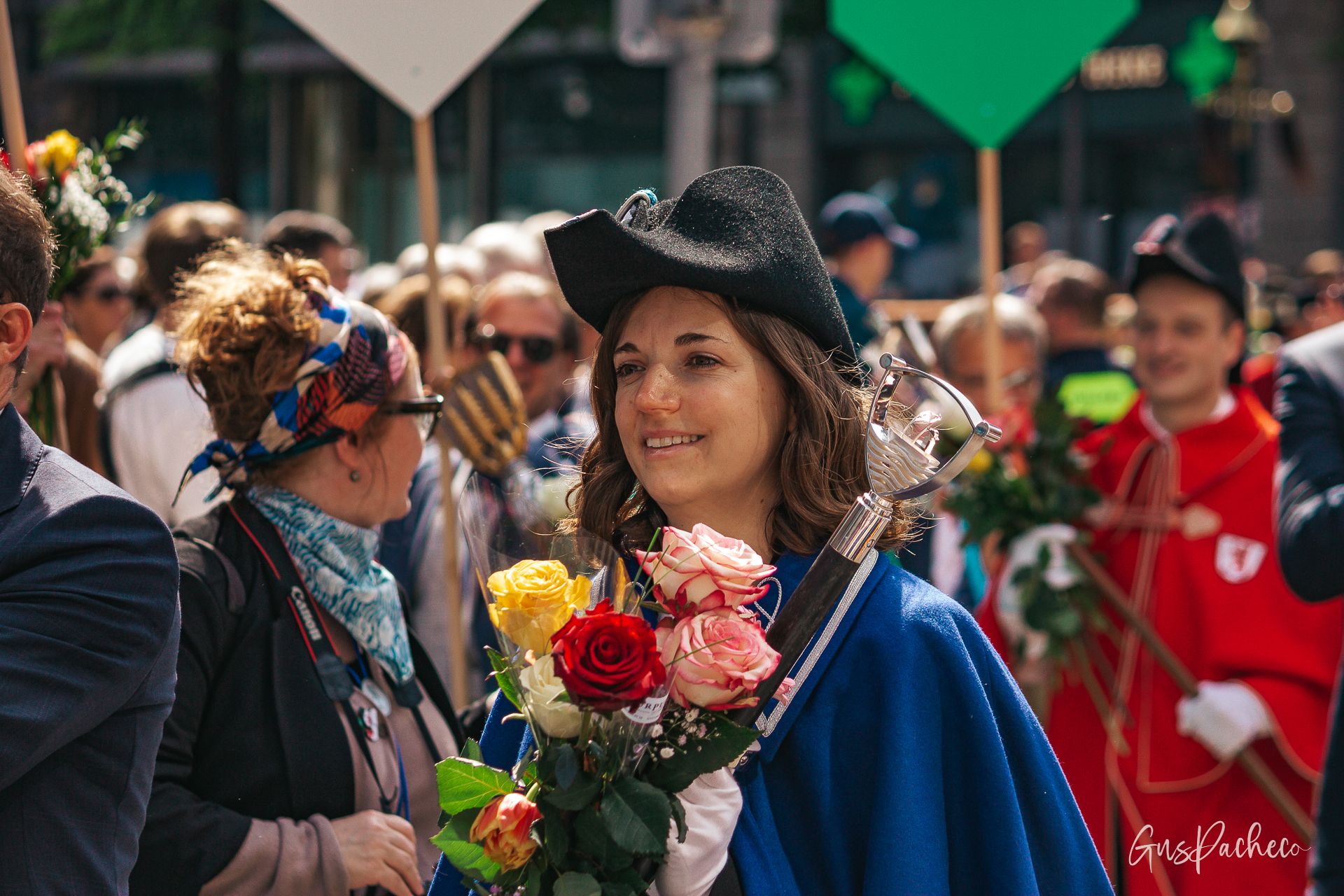
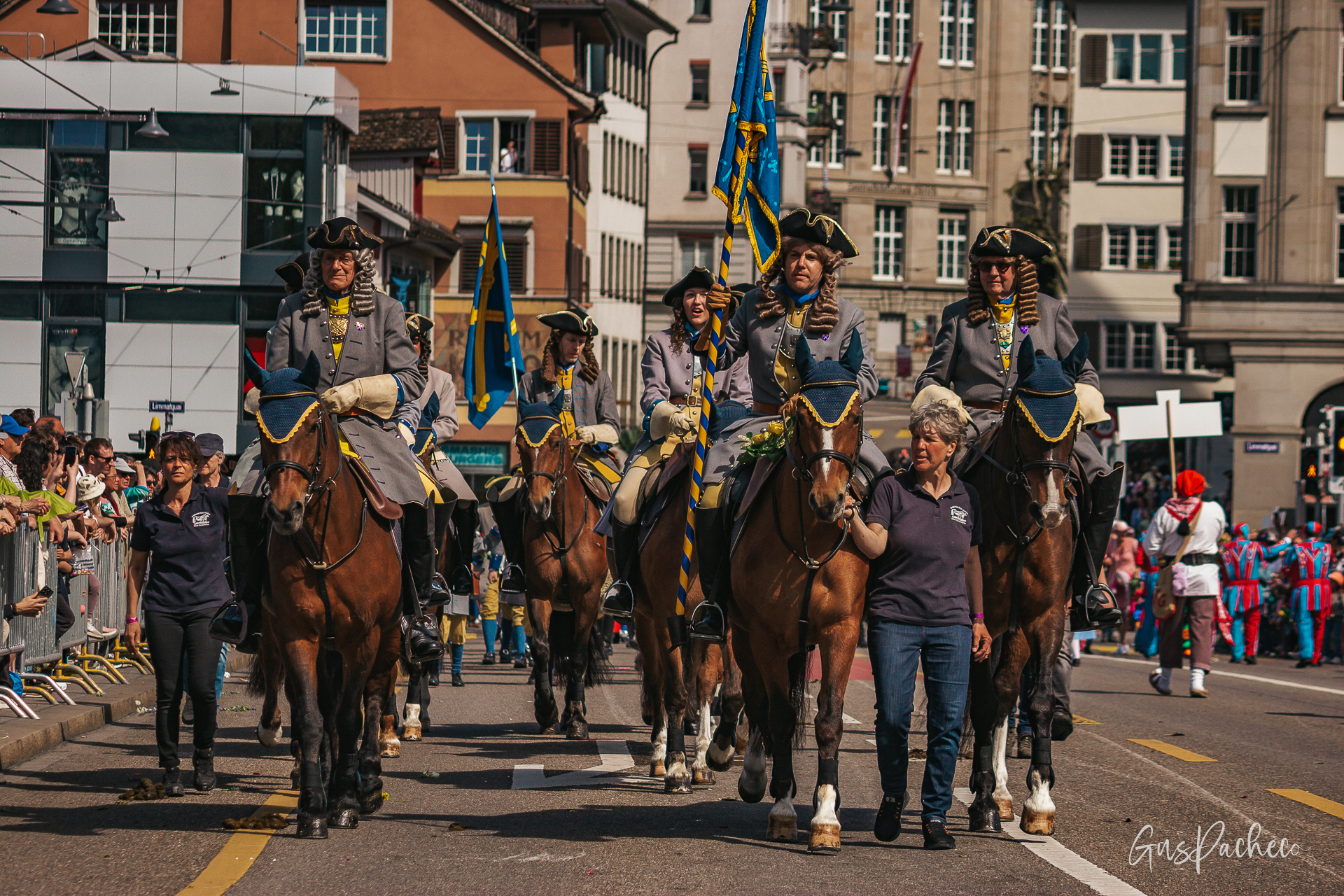
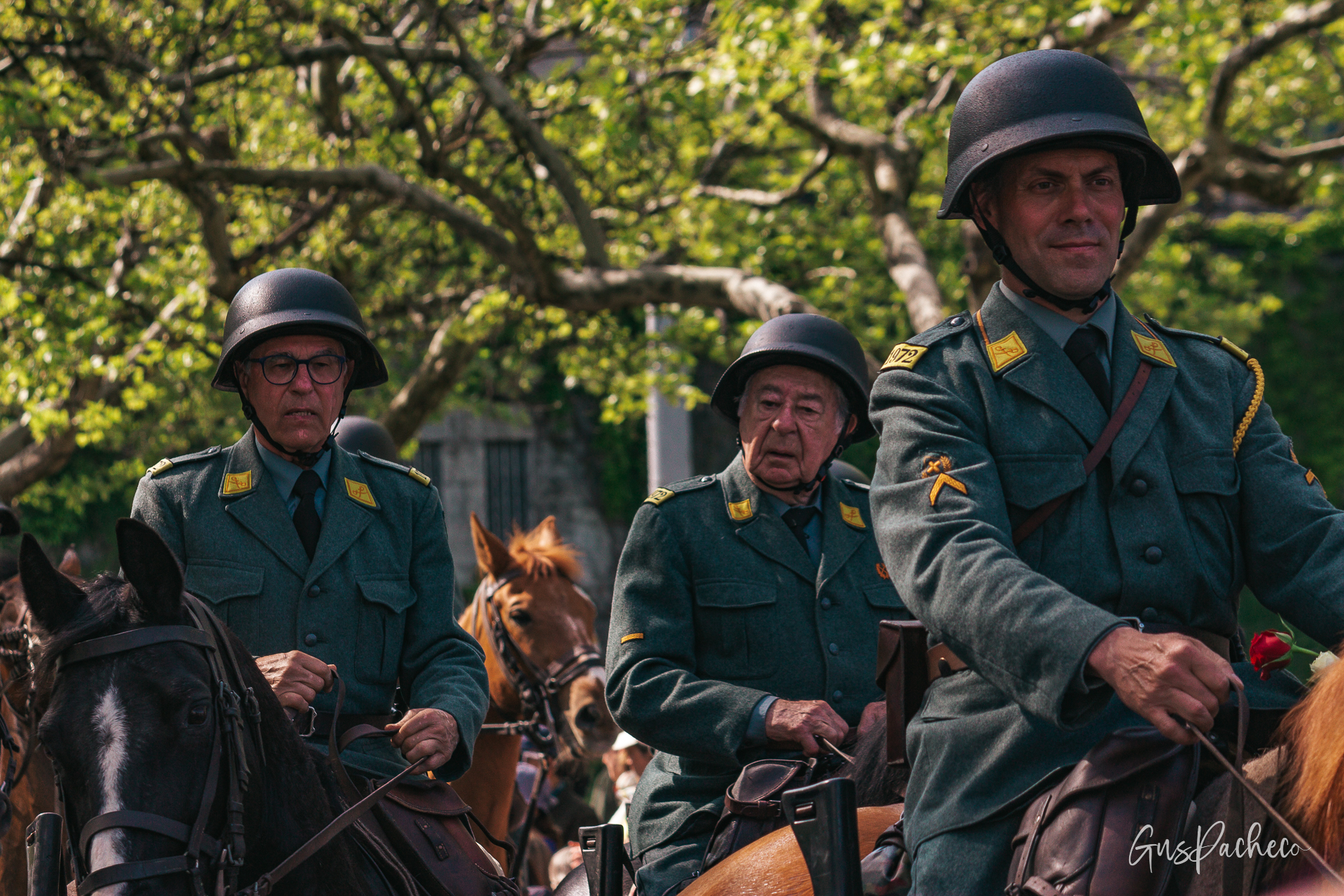
Two portraits from the parade — the energy you can only get by walking alongside it, not watching from a fixed spot. © Gus Pacheco
The Parade: Where to Be
The parade starts in the early afternoon and you have roughly two hours to move along the route, change positions, and photograph it from different angles. Don't stand in one spot. This isn't a static event — it's a river and you need to flow with it.
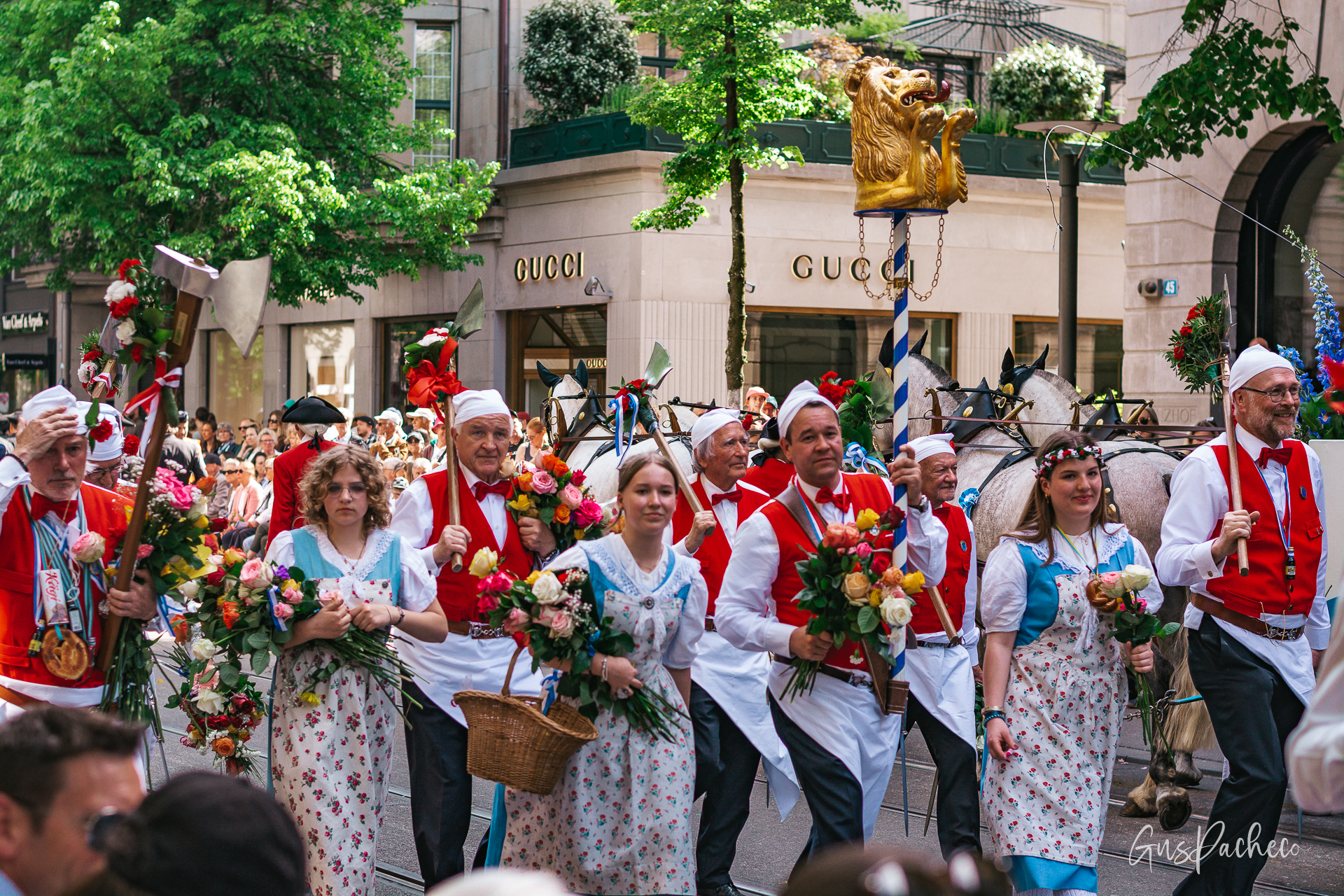
- Bahnhofstrasse midway: The street is wide enough to cross. Move alongside the parade and change angles. The guild signs in the background tell the story — "Zunfthaus zur Zimmerleuten" visible behind the drum corps is the kind of contextual layer that makes a photo.
- Paradeplatz corner: The parade turns here, which causes a natural slowdown. Faces come toward you. This is where I got the portrait of the woman with the Tricornio hat and the roses — she didn't even know I was there.
- Oetenbachgasse / elevated walls: Locals climb walls and traffic barriers to get above the crowd. Do the same. The shot looking down into the parade with the crowd behind is only possible from height.
- Sechseläutenplatz — arrive before 17:00: The burning is at 18:00 sharp and the crowd will be five to eight people deep. If you want a clear line of sight to the Böögg, you need to be there an hour early.
The Human Moments: What Nobody Photographs
Anyone with a telephoto lens can photograph the fire. The images that set this work apart are the ones most photographers walk past.
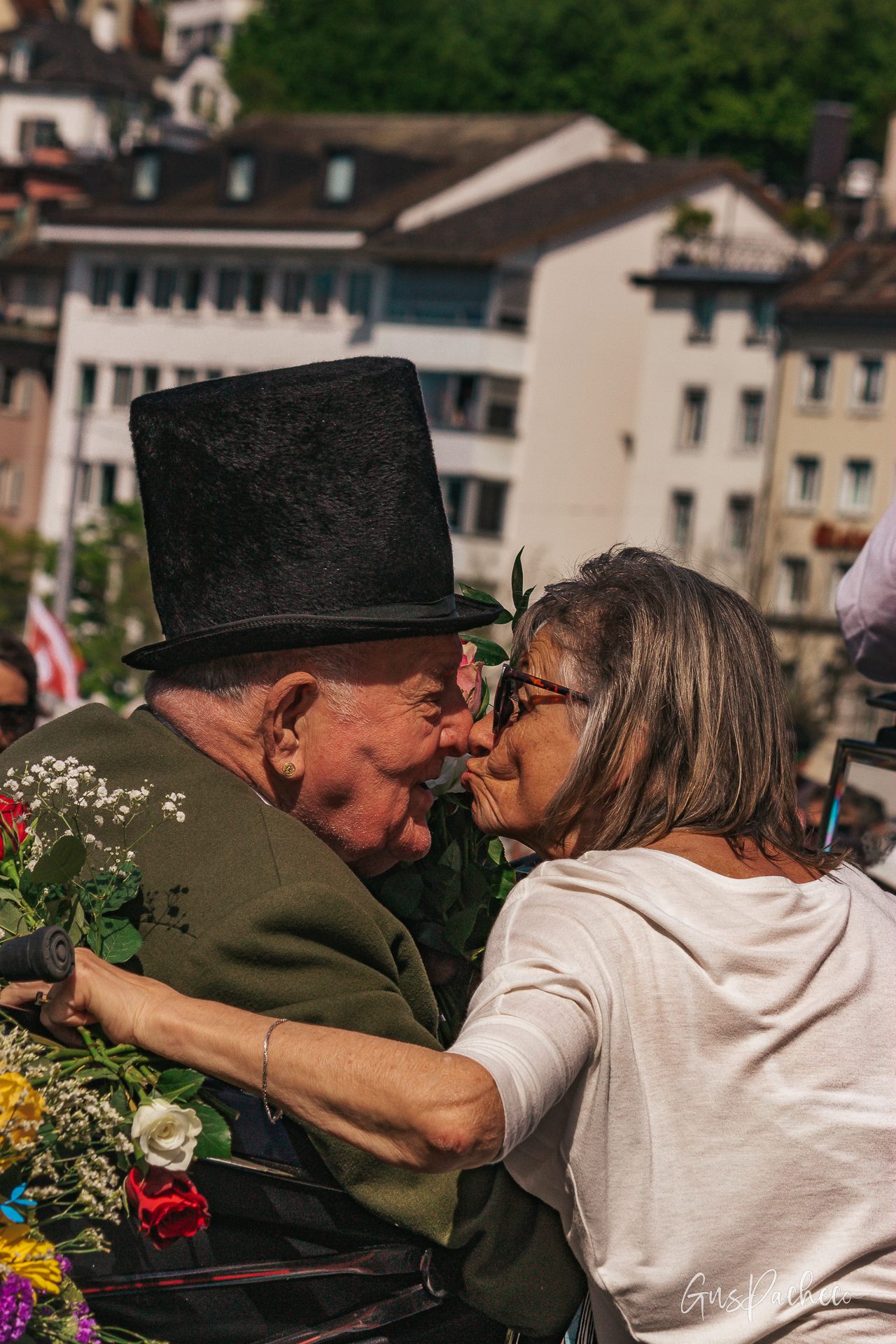
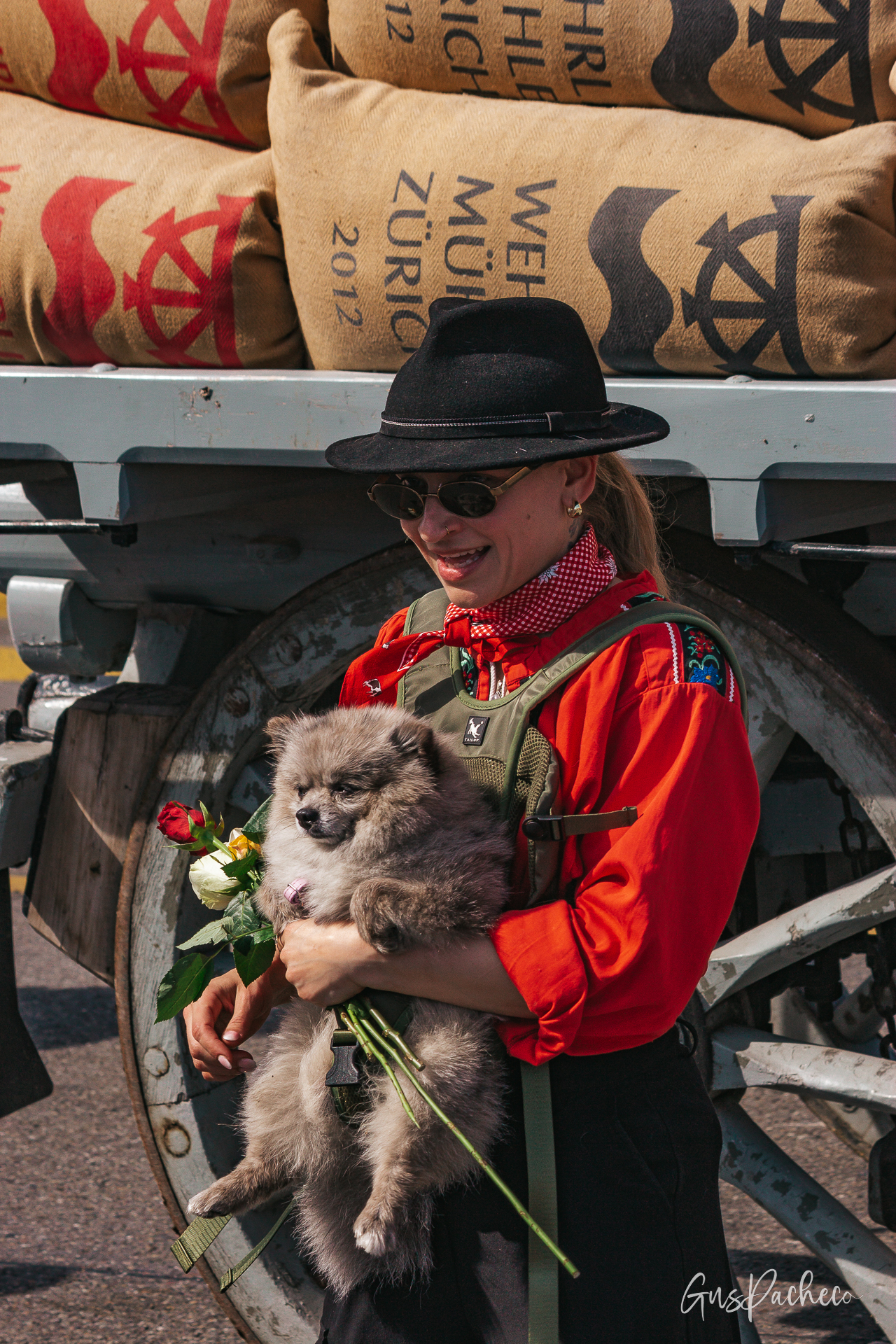
The kiss (left) is the image that stops people scrolling. The woman with the Spitz and the roses next to the old mill wagon (right) — three symbols of Zürich in a single frame. © Gus Pacheco
The elderly couple — he in a guild top hat, she reaching up to kiss him mid-parade — was captured in a fraction of a second. I almost didn't take it. I'm glad I did. That single frame says more about what Sechseläuten actually is than any wide shot of the bonfire.
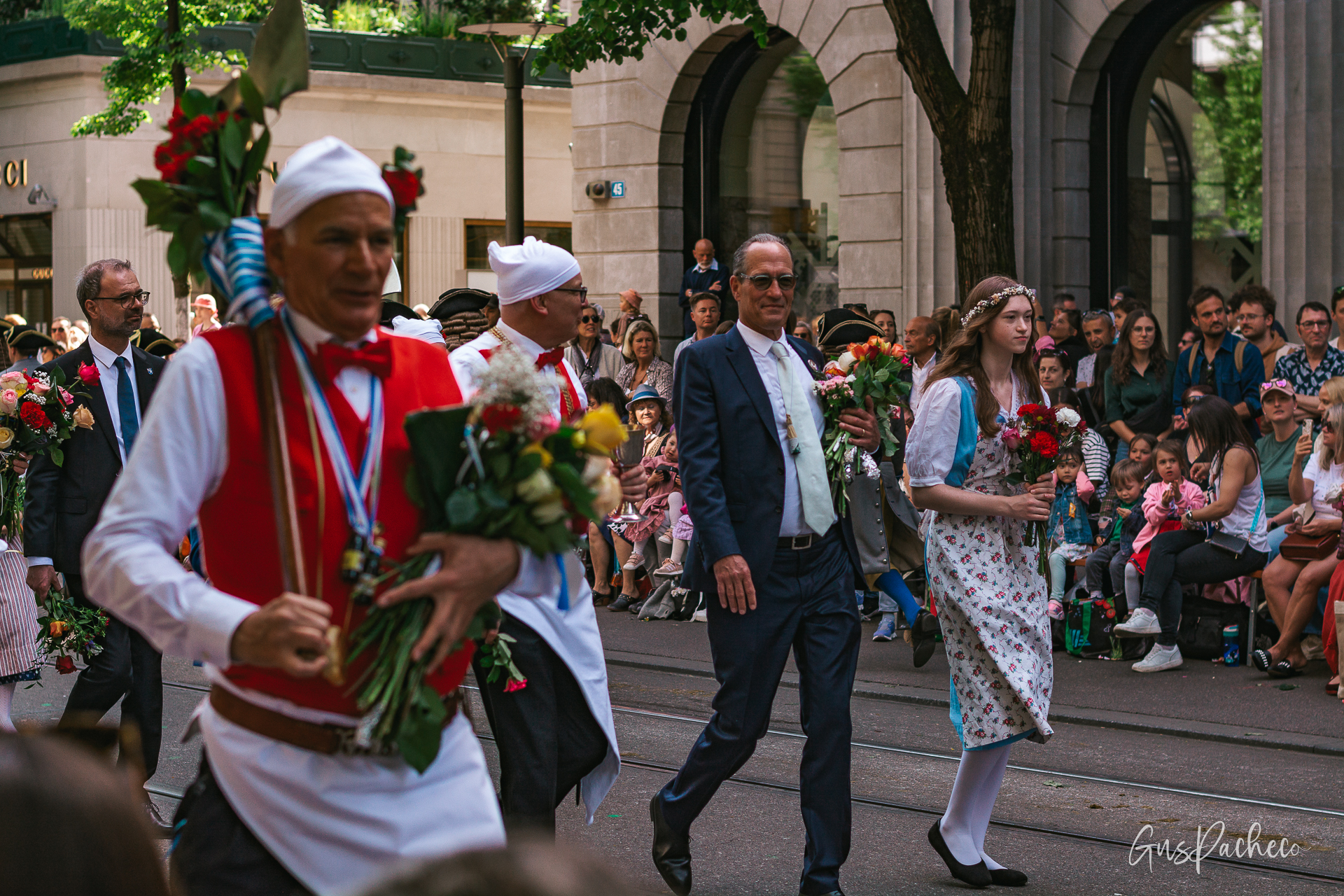
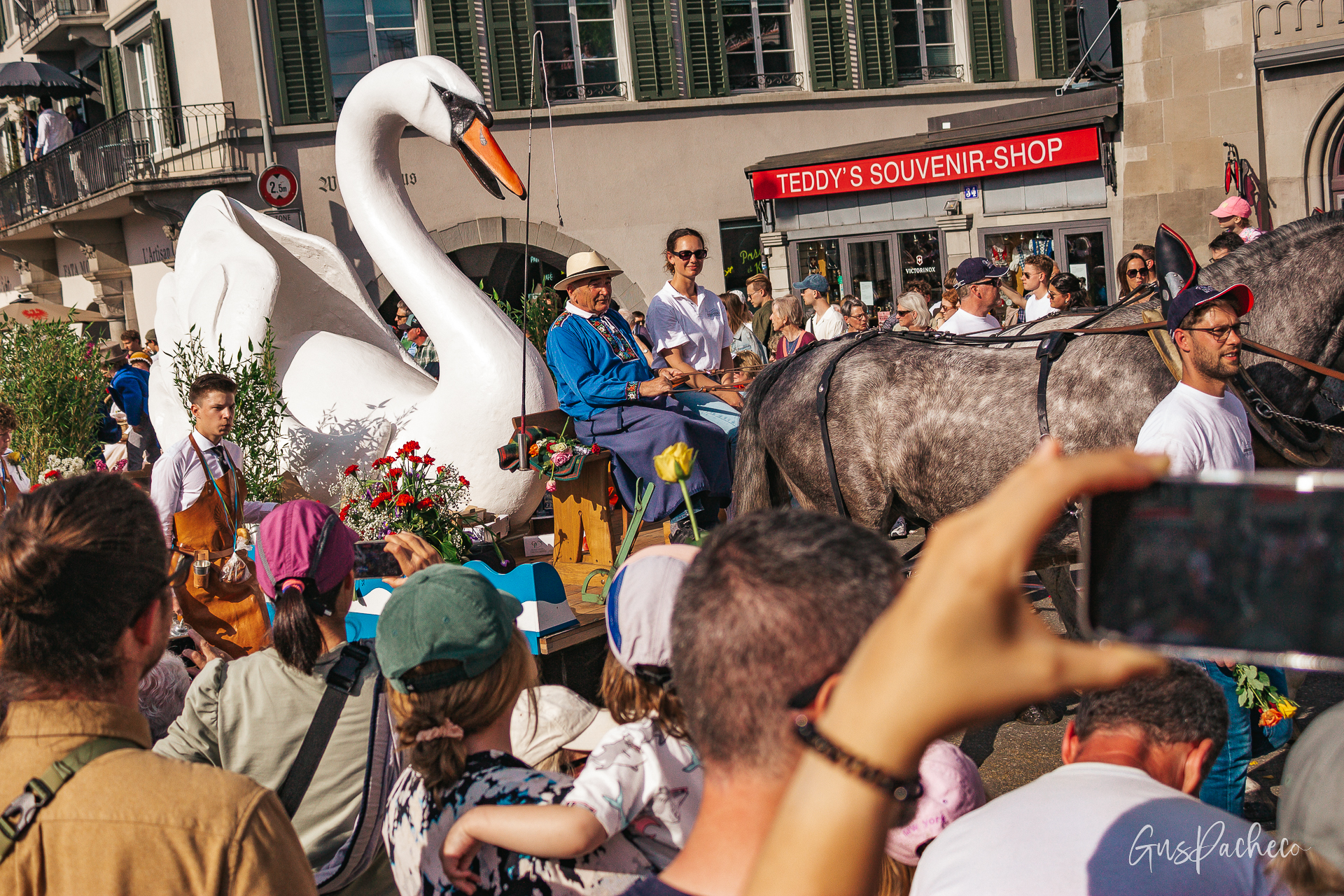
The swan float passing the Gucci store on Bahnhofstrasse — old Zürich and new Zürich in one frame. © Gus Pacheco
The Burning: How to Photograph Fire in Daylight
The Böögg is a cotton-wool snowman packed with fireworks and explosives. At 6pm, it's mounted on a bonfire at Sechseläutenplatz and lit. The clock starts. The year I was there, the head took exactly 26 minutes to explode — which according to tradition means a long and rainy winter ahead. And to be honest? That's not what happened at all. The truth is the Böögg is often wrong. MeteoSwiss has studied the correlation and the conclusion is clear: the burning time depends on how the bonfire is built, the humidity of the wood, and the weather on the day — not on what summer will bring. But I'm glad that scientific reality hasn't stopped the tradition. Some things don't need to be accurate to be worth doing.
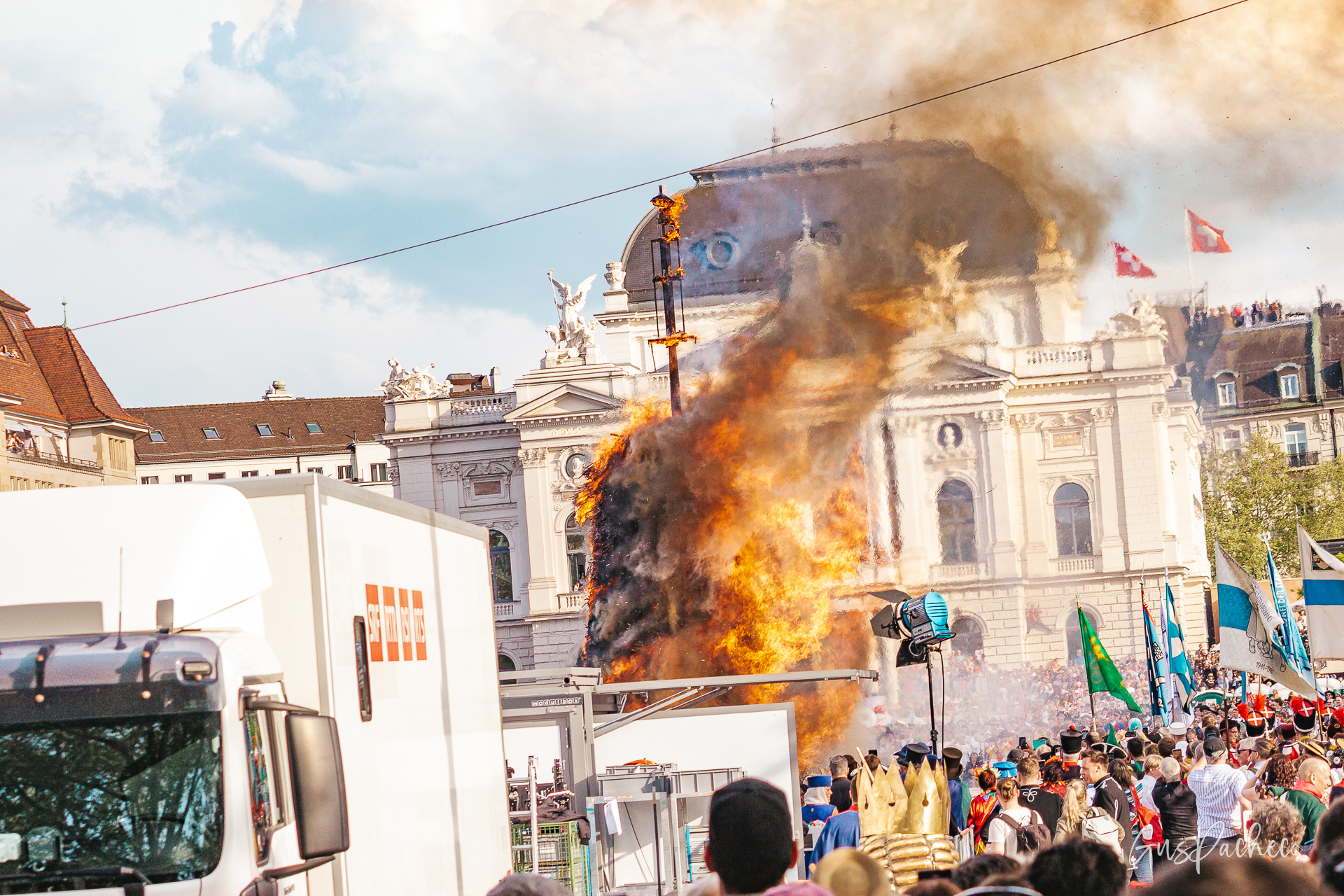
The Böögg at full burn, the Opernhaus behind, guild flags to the right, 50,000 people watching. © Gus Pacheco
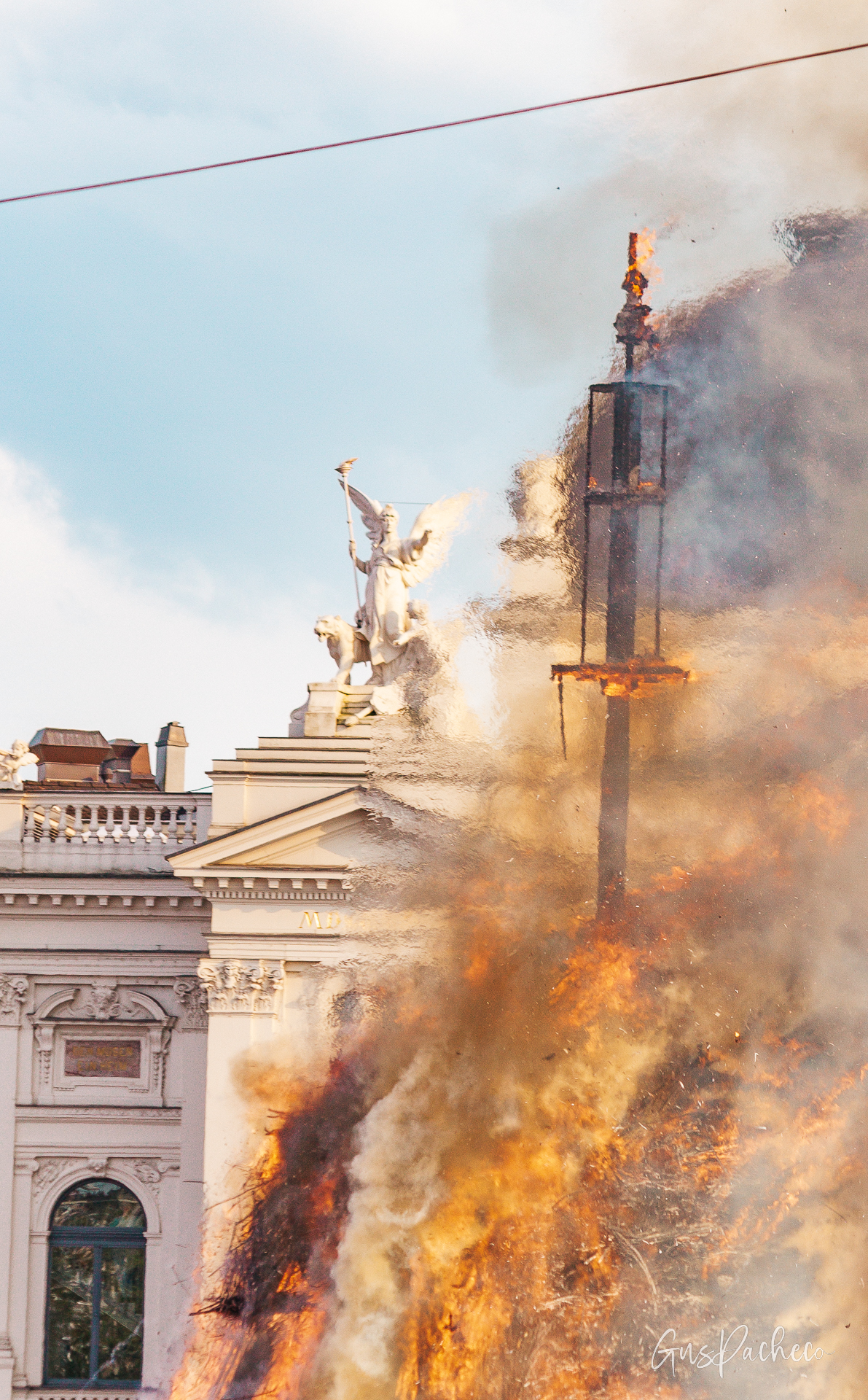
After the head explodes. What remains is the skeleton — and the smoke that makes the Opernhaus angel look like it's appearing from another century. © Gus Pacheco
Shooting the fire — what actually works
- Expose for the fire, not the scene. Your camera in Auto will expose for the overall brightness and blow out the flames. Switch to Spot Metering locked on the fire, or dial in Manual before it starts.
- Pre-focus on the Böögg before it ignites. Manually select your AF point and lock it on the figure while it's still intact. Once the smoke starts, autofocus hunts for contrast it can't find — I never trust autofocus in situations like this. Choose your point, go for it.
- Burst mode for the explosion. The fireworks go off in milliseconds. I shot at 1/1600s in burst with the 55–250mm. Even then, timing is partly luck — shoot a rafaga. And remember: the moment the head explodes, people will jump, scream, cheer. You're not just photographing fire — you're freezing time. Stay calm. Keep shooting.
- Stay after the explosion. The skeleton against the smoke, with the Opernhaus emerging behind it — that image only exists 30 seconds after the head goes. Everyone else is already cheering and leaving. Stay. Shoot.
- Include the crowd. The image with the spectator holding up his phone in the foreground is more powerful than a clean shot of the fire alone. The reaction is the story.
In My Bag That Day
Camera Body
Canon EOS 600D — APS-C crop sensor (1.6x). Entry-level body, professional results.
Primary Lens
Canon EF-S 18–55mm f/3.5–5.6 IS II — parade portraits, crowd energy, street context. Shot at f/4.5, 1/1600s, ISO 400.
Secondary Lens
Canon EF-S 55–250mm f/4–5.6 IS II — reach to the Böögg from the crowd. 146mm focal length, f/7.1, 1/500s, ISO 400.
File Format
RAW — always. Multiple SD cards. Never trust one card for a once-a-year event.
Settings (parade)
ISO 400 · f/4.5–f/7.1 · 1/500s–1/1600s depending on movement and distance.
Post-Processing
Lightroom. Summer preset as a base — the whole album took a few hours of careful editing. Clean, consistent, no heavy filters.
The 600D has a 1.6x crop factor — which means the 55–250mm becomes ~88–400mm equivalent. At 146mm focal length, you're effectively at ~234mm full-frame. More than enough reach from the crowd to isolate the Böögg. You don't need expensive gear for images like these. You need position, patience, and knowing your settings before the action starts.
The Experience — Beyond the Photos
I ate a bratwurst and had a beer while waiting for the burn. That's not optional — it's part of the ritual. But it's not just the Sechseläutenplatz: food stands appear all over the city along the parade route. Cheese, sausages, pastries, wine. It reminded me of a tequeño on the streets of Sanare, or a papa rellena in Santa Marta — that specific feeling of a city feeding itself during a celebration. It's one of the things that makes this feel like something real rather than a tourist attraction.
Standing there, in the middle of Zürich, photographing something that is simultaneously a carnival, a historical ceremony, and a neighbourhood party — I kept thinking about contrast. I've documented marches in Venezuela, the Zaragoza day in my home state. Protests and festivals in Santa Marta. The Lost City in Colombia. Every tradition has its own logic, its own texture. Sechseläuten has a texture unlike anything I'd experienced. Serious and joyful at the same time. Ancient and completely alive. Always happy to echar el cuento con mis fotos.
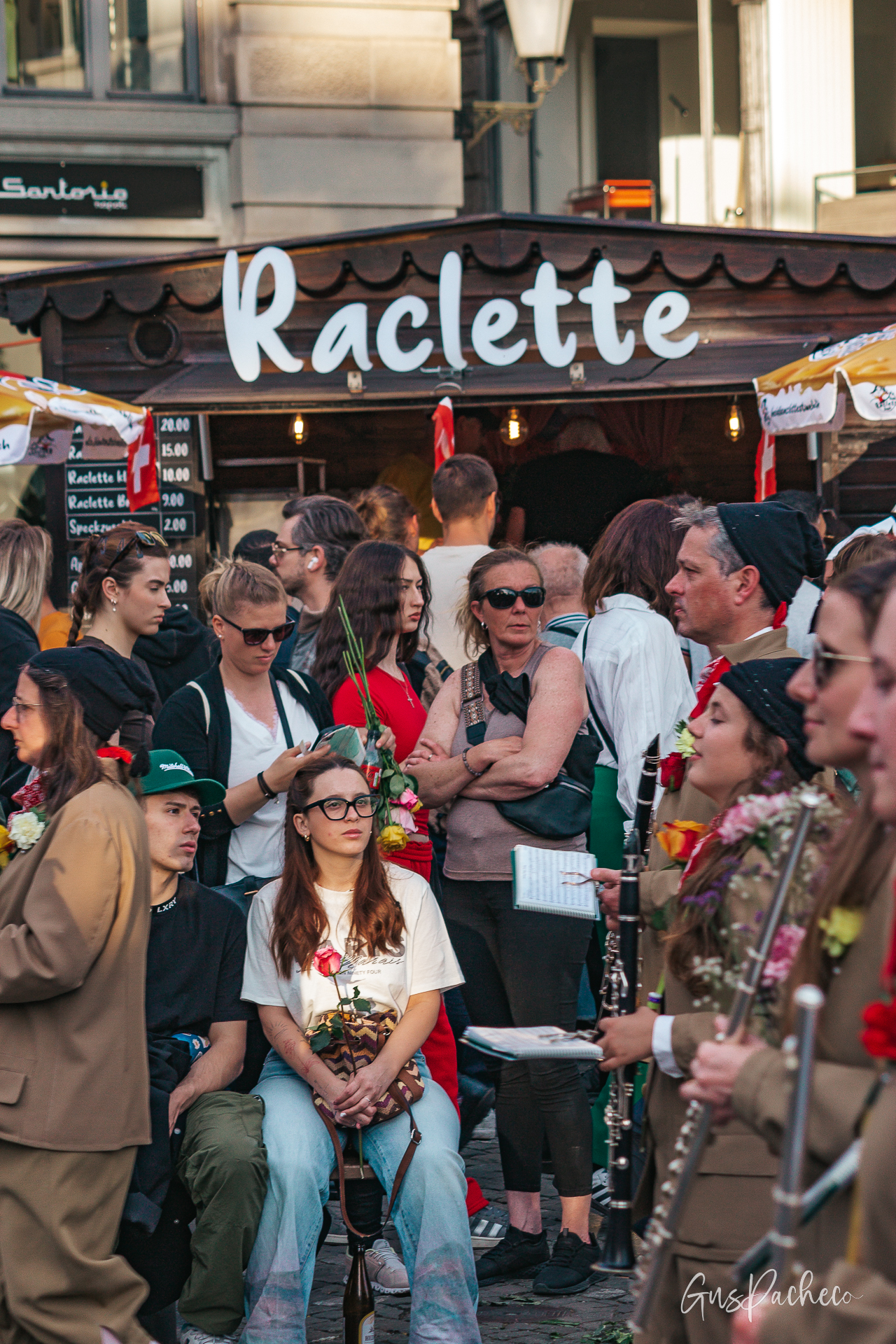
The Raclette stand on the parade route — and a man with his own miniature Böögg. Both images say something about what this city is. © Gus Pacheco
By 9pm it's over in the streets. There are private guild dinners and events continuing through the night, but the parade and the burning are a daylight affair. Everything is done before dark. Very Swiss.
Sechseläuten Photowalk
20 April 2026
Zürich · Max 8 people · CHF 30
This April 20th I'm taking a small group to photograph the guilds, the parade, and the burning — from the best positions, with a guide who has already been there and knows exactly where to be and when. You bring your camera (or phone). I bring the knowledge.
Practical Information
WhenThird Monday of April. Parade from ~14:00, burning at 18:00 sharp.
WhereParade: Bahnhofstrasse → Paradeplatz → Bellevue. Burning: Sechseläutenplatz.
TransportTram 2/4/8/9 to Bellevue. From Zürich HB, 10 min walk or tram 4.
CostFree — no tickets, no barriers. Just show up and respect the space.
What to PackLayers (April = unpredictable), water, sunscreen, snacks. Ends at 21:00.
Photographer's Note50mm + 70–300mm. Arrive at Sechseläutenplatz before 17:00 for position.
Parade Route
The Route — Zürich, April
The parade covers approximately 4km through central Zürich. Each stop below marks a different photographic opportunity.
01Lindenhügel
Assembly from 13:00. Wide streets, full guild display.
02Bahnhofstrasse
Move alongside it. Zunfthaus signs in background.
03Paradeplatz
Parade turns here. Faces come toward you. Best portraits.
04Bellevue
Lake light, afternoon glow. Best backdrop shot.
05Sechseläutenplatz
Arrive before 17:00. Burning at 18:00 sharp.
See Zürich Like This
Want to photograph
Zürich with a guide?
Small-group photowalks with Gus — max 8 people, guided by a Venezuelan photojournalist who has called Zürich home for years. CHF 30 per person.
Era una mañana fresca de abril, unos 19 grados. Caminé diez minutos hasta la estación de tren de Schofflisdorf con una Quöllfrisch fría en la mano — algo que ya se había convertido en un ritual cada vez que tocaba ir a Zürich con la cámara. Pero este día era diferente: era mi primer Sechseläuten.
El año anterior lo había visto desde el teléfono, a más de 8.000 kilómetros de distancia. ¿Una locura? Sí. Absolutamente. Y aquí estaba.
En el tren, en cada parada, ya se veía el ambiente. Al llegar a Zürich HB fue encontrarme de frente con una marea humana en movimiento — disfraces, músicos, fotógrafos, todo el mundo yendo hacia el mismo lugar. No sabía por dónde empezar. Solo sabía que quería que fuera auténtico. Así que hice lo más simple posible: caminar hacia donde sonaba la música.
Así encontré el desfile.
La escala del evento desde arriba: el desfile llenando el Limmatquai, la torre del Fraumünster al fondo. El Zürich que no aparece en los folletos de viaje. © Gus Pacheco
¿Qué es el Sechseläuten?
El nombre significa "el toque de las seis" — el momento en que las campanas del Grossmünster anunciaban el fin de la jornada laboral de invierno. Durante siglos, así marcaba Zürich el cambio de estación. Hoy ocurre cada tercer lunes de abril y es una de las cosas más espectaculares que he fotografiado en mi vida.
Más de 25 gremios (*Zünfte*) de Zürich se congregan en un desfile que recorre Bahnhofstrasse, Paradeplatz y la ribera del Limmat antes de llegar a Sechseläutenplatz, frente a la Ópera. Cada gremio representa siglos de tradición — panaderos, carpinteros, mercaderes, molineros, cada uno con su propio traje, su propia música, su propio carácter. Hay caballos, carrozas decoradas, bandas de metales, y personas en traje de época que genuinamente parecen salidas de 1631.
Y a las 6 de la tarde, queman un muñeco de nieve.
El Böögg lleva más de 160 años prediciendo el verano suizo. Cuanto más rápido explota la cabeza, mejor el verano. Toda la ciudad observa en silencio — y luego estalla.
— Ritual primaveral de Zürich · Documentado por primera vez en 1892
Dos retratos del desfile — la energía que solo se consigue caminando junto al desfile, no observándolo desde un punto fijo. © Gus Pacheco
El Desfile: Dónde Estar
El desfile empieza a primera hora de la tarde y tienes aproximadamente dos horas para moverte por el recorrido, cambiar de posición y fotografiarlo desde distintos ángulos. No te quedes en un solo sitio. Esto no es un evento estático — es un río y necesitas fluir con él.
- Mitad de Bahnhofstrasse: La calle es suficientemente ancha para cruzar. Muévete junto al desfile y cambia ángulos. Los rótulos de los Zunfthäuser al fondo dan contexto — son el tipo de capa narrativa que convierte una foto en una historia.
- Esquina de Paradeplatz: El desfile gira aquí, lo que causa una desaceleración natural. Las caras vienen hacia ti. Aquí conseguí el retrato de la mujer con el sombrero tricornio y las rosas — ni siquiera sabía que la estaba fotografiando.
- Oetenbachgasse / muros elevados: Los locales se suben a muros y barreras para estar por encima de la multitud. Haz lo mismo. La toma desde arriba hacia el desfile solo existe desde la altura.
- Sechseläutenplatz — llega antes de las 17:00: La quema es a las 18:00 en punto y la multitud tendrá entre cinco y ocho personas de profundidad. Si quieres línea visual clara al Böögg, necesitas estar ahí con una hora de antelación.
Los Momentos Humanos: Lo Que Nadie Fotografía
El beso (izquierda) es la imagen que detiene el scroll. La mujer con el Spitz y las rosas junto al antiguo carro de molino (derecha) — tres símbolos de Zürich en un solo encuadre. © Gus Pacheco
La pareja de ancianos — él con el sombrero de copa del gremio, ella alcanzando para besarlo en mitad del desfile — se capturó en una fracción de segundo. Casi no la tomé. Me alegra haberlo hecho. Ese único fotograma dice más sobre lo que el Sechseläuten realmente es que cualquier toma amplia de la hoguera.
La Quema: Cómo Fotografiar Fuego a Pleno Sol
El Böögg es un muñeco de nieve de algodón relleno de fuegos artificiales y explosivos. A las 6pm, se monta sobre una hoguera en Sechseläutenplatz y se enciende. Empieza el reloj. El año que estuve, la cabeza tardó exactamente 26 minutos en explotar — lo que según la tradición anuncia un invierno largo y lluvioso. ¿Y sabes qué? No fue así para nada. La verdad es que el Böögg se equivoca a menudo. MeteoSwiss lo ha estudiado y la conclusión es clara: el tiempo de combustión depende de cómo se construye la hoguera, la humedad de la madera y el clima del día — no del verano que viene. Pero me alegra que esa realidad científica no haya detenido la tradición. Algunas cosas no necesitan ser exactas para valer la pena.
El Böögg a plena combustión, la Ópera detrás, banderas de los gremios a la derecha, 50.000 personas mirando. © Gus Pacheco
Después de que explota la cabeza. Lo que queda es el esqueleto — y el humo que hace que el ángel de la Ópera parezca llegar desde otro siglo. © Gus Pacheco
Cómo fotografiar el fuego — lo que realmente funciona
- Expón para el fuego, no para la escena. En Auto, tu cámara expondrá para el brillo general y quemará las llamas. Cambia a Medición Puntual anclada en el fuego, o ajusta Manual antes de que empiece.
- Pre-enfoca en el Böögg antes de que prenda. Ajusta el enfoque manualmente o bloquea AF-C en la figura mientras aún está intacta. Una vez que empieza el humo, el autoenfoque busca contraste que no encuentra.
- Modo ráfaga para la explosión. Los fuegos artificiales se disparan en milisegundos. Yo disparé a 1/1600s–1/2000s en ráfaga. Aún así, el momento es cuestión de suerte — dispara mucho.
- Quédate después de la explosión. El esqueleto contra el humo, con la Ópera emergiendo detrás — esa imagen solo existe 30 segundos después de que explota la cabeza. Todos los demás ya están celebrando y marchándose. Quédate. Dispara.
Lo que llevé ese día
CuerpoCanon EOS 600D — sensor APS-C recortado (1.6x). Cámara de entrada, resultados profesionales.
Objetivo principalCanon EF-S 18–55mm f/3.5–5.6 IS II — retratos del desfile, energía callejera, contexto amplio. Disparado a f/4.5, 1/1600s, ISO 400.
Objetivo secundarioCanon EF-S 55–250mm f/4–5.6 IS II — alcance al Böögg desde la multitud. 146mm de distancia focal, f/7.1, 1/500s, ISO 400.
FormatoRAW siempre. Varias tarjetas SD. Nunca confíes en una sola tarjeta para un evento anual.
Ajustes (desfile)ISO 400 · f/4.5–f/7.1 · 1/500s–1/1600s según el movimiento y la distancia.
EdiciónLightroom. Preset de verano como base — el álbum completo me llevó unas horas de edición cuidadosa. Limpio, consistente, sin filtros pesados.
La 600D tiene factor de recorte 1.6x — lo que significa que el 55–250mm equivale a ~88–400mm en full frame. A 146mm de distancia focal, estás efectivamente a ~234mm equivalente. Más que suficiente alcance desde la multitud para aislar el Böögg. No necesitas equipo caro para hacer imágenes como estas. Necesitas posición, paciencia y saber tus ajustes antes de que empiece la acción.
La Experiencia — Más Allá de las Fotos
Comí una bratwurst y tomé una cerveza mientras esperaba la quema. Eso no es opcional — es parte del ritual. Pero no es solo en Sechseläutenplatz: puestos de comida aparecen por toda la ciudad a lo largo del recorrido del desfile. Queso, salchichas, pasteles, vino. Me recordó a un tequeño en las calles de Sanare, o una papa rellena en la Samaria — esa sensación específica de una ciudad que se alimenta durante su propia celebración. Es una de las cosas que hacen que esto se sienta real y no como una atracción turística.
Parado ahí, en el centro de Zürich, fotografiando algo que es a la vez un carnaval, una ceremonia histórica y una fiesta de barrio — no podía dejar de pensar en el contraste. He documentado marchas en Venezuela, el día de Zaragoza en mi estado. Protestas y festivales en Santa Marta. La Ciudad Perdida en Colombia. Cada tradición tiene su propia lógica, su propia textura. El Sechseläuten tiene una textura distinta a todo lo que había vivido. Serio y alegre al mismo tiempo. Antiguo y completamente vivo. Siempre feliz de poder echar el cuento con mis fotos.
A las 9pm todo termina en la calle. Habrá cenas privadas de los gremios y eventos que continúan toda la noche, pero el desfile y la quema son cosas de luz de día. Todo termina antes de que oscurezca. Muy suizo.
Photowalk Sechseläuten
20 de abril 2026
Zürich · Máx 8 personas · CHF 30
Este 20 de abril llevo un grupo pequeño a fotografiar los gremios, el desfile y la quema — desde las mejores posiciones, con un guía que ya ha estado y sabe exactamente dónde hay que estar y cuándo. Tú traes la cámara (o el teléfono). Yo pongo el conocimiento. ¿Te apuntas?
Información Práctica
CuándoTercer lunes de abril. Desfile desde ~14:00, quema a las 18:00 en punto.
DóndeDesfile: Bahnhofstrasse → Paradeplatz → Bellevue. Quema: Sechseläutenplatz.
TransporteTranvía 2/4/8/9 a Bellevue. Desde Zürich HB, 10 min a pie o tranvía 4.
PrecioGratis — sin tickets, sin barreras. Solo preséntate y respeta el espacio.
Qué llevarCapas (abril = impredecible), agua, protector solar, snacks. Termina a las 21:00.
Nota para fotógrafos50mm + 70–300mm. Llega a Sechseläutenplatz antes de las 17:00 para posicionarte.
Recorrido del Desfile
La Ruta — Zürich, Abril
El desfile cubre aproximadamente 4km por el centro de Zürich. Cada punto marca una oportunidad fotográfica diferente.
01Lindenhügel
Concentración desde las 13:00. Calles anchas, gremios completos.
02Bahnhofstrasse
Camina junto al desfile. Zunfthäuser al fondo.
03Paradeplatz
El desfile gira aquí. Las caras vienen hacia ti. Mejores retratos.
04Bellevue
Luz del lago, resplandor de tarde. Mejor fondo del día.
05Sechseläutenplatz
Llega antes de las 17:00. Quema a las 18:00 en punto.
Fotografía Zürich Así
¿Quieres fotografiar
Zürich con guía?
Photowalks en grupos pequeños con Gus — máximo 8 personas, guiados por un fotoperiodista venezolano que lleva años viviendo en Zürich. CHF 30 por persona.
Es war ein kühler Aprilmorgen — etwa 19 Grad. Ich lief zehn Minuten zum Bahnhof Schofflisdorf mit einer kalten Quöllfrisch in der Hand. Das war bereits zu einem Ritual geworden an Tagen, wenn ich mit der Kamera nach Zürich fuhr. Aber dieser Tag war anders: Es war mein erstes Sechseläuten.
Ein Jahr zuvor hatte ich es vom Handy aus verfolgt, über 8.000 Kilometer entfernt. Verrückt? Ja. Absolut. Und jetzt war ich hier.
Im Zug, an jeder Haltestelle, war die Stimmung bereits spürbar. Am Zürich HB angekommen, traf ich auf eine Menschenmenge in Bewegung — Kostüme, Musiker, Fotografen, alle in dieselbe Richtung. Ich wusste nicht, wo ich anfangen sollte. Ich wusste nur, dass es authentisch sein sollte. Also tat ich das Einfachste: Ich folgte der Musik.
So fand ich den Umzug.
Das Ausmass des Festes von oben: der Umzug füllt den Limmatquai, das Fraumünster im Hintergrund. Das Zürich, das man in keinem Reiseprospekt findet. © Gus Pacheco
Was ist das Sechseläuten?
Der Name bedeutet «das Sechsuhrläuten» — der Moment, in dem die Glocken des Grossmünsters das Ende des Winterarbeitstages ankündigten. Jahrhundertelang markierte Zürich so den Jahreszeitenwechsel. Heute findet es jeden dritten Montag im April statt und ist eines der spektakulärsten Ereignisse, die ich je fotografiert habe.
Über 25 Zünfte Zürichs versammeln sich für einen Umzug, der durch die Bahnhofstrasse, den Paradeplatz und entlang der Limmat führt, bevor er auf dem Sechseläutenplatz vor dem Opernhaus endet. Jede Zunft repräsentiert Jahrhunderte der Tradition — Bäcker, Zimmerleute, Kaufleute, Müller, jede mit eigenem Kostüm, eigener Musik, eigenem Charakter. Es gibt Pferde, geschmückte Wagen, Blaskapellen und Menschen in historischem Gewand, die tatsächlich wie aus dem Jahr 1631 zu stammen scheinen.
Und um 18 Uhr verbrennen sie einen Schneemann.
Der Böögg sagt seit über 160 Jahren den Schweizer Sommer voraus. Je schneller der Kopf explodiert, desto besser der Sommer. Die ganze Stadt schaut in Stille zu — und bricht dann aus.
— Zürcher Frühlingsritual · Erstmals dokumentiert 1892
Zwei Porträts aus dem Umzug — die Energie, die man nur bekommt, wenn man neben dem Zug läuft und nicht von einem festen Punkt aus zuschaut. © Gus Pacheco
Der Umzug: Wo Man Sein Sollte
- Mitte der Bahnhofstrasse: Die Strasse ist breit genug zum Überqueren. Laufen Sie neben dem Umzug und wechseln Sie die Perspektive. Die Zunfthausschilder im Hintergrund erzählen die Geschichte.
- Ecke Paradeplatz: Der Umzug biegt hier ab, was eine natürliche Verlangsamung verursacht. Gesichter kommen auf Sie zu. Hier entstehen die besten Porträts.
- Sechseläutenplatz — vor 17:00 Uhr ankommen: Die Verbrennung findet um 18:00 Uhr statt und die Menschenmenge ist fünf bis acht Personen tief. Für eine freie Sichtlinie auf den Böögg müssen Sie eine Stunde früher da sein.
Die Verbrennung
Der Böögg ist ein mit Watte gefüllter Schneemann voller Feuerwerkskörper und Sprengstoff. Um 18 Uhr wird er auf einem Scheiterhaufen auf dem Sechseläutenplatz aufgestellt und angezündet. Die Uhr läuft. Dieses Jahr dauerte es genau 26 Minuten, bis der Kopf explodierte — was laut Tradition einen durchschnittlichen Sommer ankündigt. Und ehrlich gesagt? Der Sommer 2025 war einer der heissesten je gemessen. Der Böögg lag falsch — aber das hat die Tradition zum Glück nicht gestoppt.
Der Böögg in voller Flamme, das Opernhaus dahinter, Zunftfahnen rechts, 50.000 Menschen schauend. © Gus Pacheco
Nach der Explosion: das Skelett, und der Rauch lässt den Engel des Opernhauses aus einem anderen Jahrhundert erscheinen. © Gus Pacheco
Meine Ausrüstung an diesem Tag
KameraCanon EOS 600D — APS-C Crop-Sensor (1,6x). Einsteigerkamera, professionelle Ergebnisse.
HauptobjektivCanon EF-S 18–55mm f/3,5–5,6 IS II — Porträts, Strassenstimmung, Kontext. Einstellungen: f/4,5, 1/1600s, ISO 400.
Zweites ObjektivCanon EF-S 55–250mm f/4–5,6 IS II — Reichweite zum Böögg aus der Menge. 146mm Brennweite, f/7,1, 1/500s, ISO 400.
FormatRAW immer. Mehrere SD-Karten. Vertrauen Sie bei einem Jahresereignis nie einer einzigen Karte.
Einstellungen (Umzug)ISO 400 · f/4,5–f/7,1 · 1/500s–1/1600s je nach Bewegung und Distanz.
NachbearbeitungLightroom. Sommer-Preset als Basis — dann intensive Arbeit bei den wichtigsten Bildern.
Die 600D hat einen 1,6x Crop-Faktor — das bedeutet, das 55–250mm entspricht ~88–400mm Kleinbild-äquivalent. Bei 146mm Brennweite sind das effektiv ~234mm. Mehr als genug Reichweite aus der Menge, um den Böögg zu isolieren. Sie brauchen keine teure Ausrüstung für solche Bilder. Sie brauchen Position, Geduld und die richtigen Einstellungen, bevor die Aktion beginnt.
Der Kuss (links) ist das Bild, bei dem man aufhört zu scrollen. Die Frau mit dem Spitz und den Rosen neben dem alten Mühlenwagen (rechts) — drei Symbole Zürichs in einem einzigen Bild. © Gus Pacheco
Ich ass eine Bratwurst und trank ein Bier während des Wartens. Das ist kein Bonus — das ist Teil des Rituals. Die Essenstände rund um den Sechseläutenplatz, der Geruch von Grillgut vermischt mit Holzrauch — das alles gehört dazu und macht es real.
Sechseläuten Fotowalk
20. April 2026
Zürich · Max. 8 Personen · CHF 30
Am 20. April führe ich eine kleine Gruppe durch den Zug der Zünfte, die Parade und die Verbrennung — von den besten Positionen aus, mit einem Guide, der bereits dabei war und genau weiss, wo man wann stehen muss. Du bringst deine Kamera (oder dein Handy). Ich bringe das Wissen.
Praktische Informationen
WannDritter Montag im April. Umzug ab ~14:00, Verbrennung um 18:00 Uhr.
WoUmzug: Bahnhofstrasse → Paradeplatz → Bellevue. Verbrennung: Sechseläutenplatz.
AnreiseTram 2/4/8/9 bis Bellevue. Vom Zürich HB 10 Min. zu Fuss oder Tram 4.
EintrittKostenlos — keine Tickets, keine Absperrungen. Einfach hingehen und den Platz respektieren.
EmpfehlungSchichten (April = unberechenbar), Wasser, Sonnenschutz, Snacks. Endet um 21:00.
Für Fotografen50mm + 70–300mm. Vor 17:00 am Sechseläutenplatz sein, um eine gute Position zu bekommen.
Umzugsroute
Die Route — Zürich, April
Der Umzug erstreckt sich über ca. 4 km durch die Zürcher Innenstadt.
01Lindenhügel
Aufstellung ab 13:00. Breite Strassen, alle Zünfte sichtbar.
02Bahnhofstrasse
Neben dem Umzug laufen. Zunfthäuser im Hintergrund.
03Paradeplatz
Biegung = Verlangsamung. Gesichter kommen auf Sie zu.
04Bellevue
Seelicht, Nachmittagsglanz. Bester Hintergrund des Tages.
05Sechseläutenplatz
Vor 17:00 ankommen. Verbrennung um 18:00 Uhr.
Zürich so erleben
Zürich fotografieren
mit einem Guide?
Kleine Fotowalks mit Gus — max. 8 Personen, geführt von einem venezolanischen Fotojournalisten, der seit Jahren in Zürich lebt. CHF 30 pro Person.